

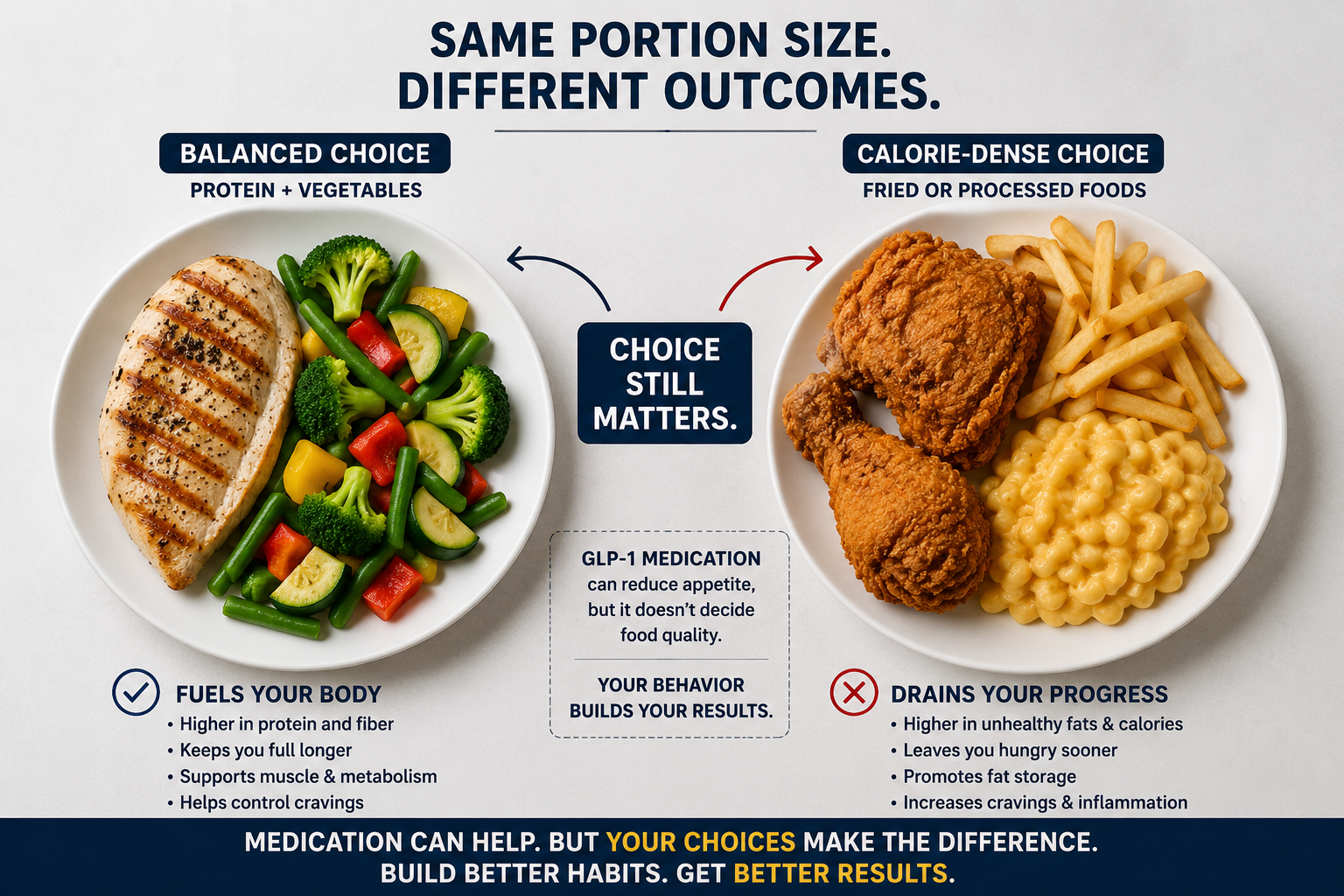
Why GLP-1s Work - And Why They Still Fails for Some People
AT A GLANCE
GLP-1 medications support weight loss by reducing appetite, slowing digestion, and improving blood sugar control. But without changes in behavior and structure, these benefits can be overridden.
HOW GLP-1 CHANGES THE BIOLOGY
GLP-1 medications work by directly influencing systems that regulate hunger and metabolism.
They reduce appetite signals, slow gastric emptying so food stays in the stomach longer and improve how the body manages blood sugar. For many patients, this leads to fewer cravings, smaller portions, and more consistent intake throughout the day.
That is a meaningful shift.
For people who have struggled with constant hunger or unstable eating patterns, this creates a level of control that may not have been possible before. The body is no longer working against them in the same way.
But that biological support has limits.

WHY THE BENEFIT CAN BE OVERRIDDEN
“There Are No Magic Pills.”
GLP-1’s can reduce hunger, but it does not remove choice.
It is still possible to eat calorie-dense foods. It is still possible to snack out of habit rather than hunger. It is still possible to exceed what the body needs, even with reduced appetite.
The medication changes the signal. It does not control the response.
When behavior remains unstructured, the benefit begins to erode. The same patterns—unmeasured portions, inconsistent meals, high-calorie foods—can gradually override the advantage the medication provides.
WHY APPETITE REDUCTION IS NOT ENOUGH
A lower appetite does not automatically lead to better decisions.
Some patients eat less frequently, but still choose foods that are high in calories and low in satiety. Others rely on the absence of hunger and stop paying attention to portion size entirely.
Over time, this leads to a mismatch. Intake may be lower than before, but not low enough to create consistent progress.
“Most people are not lacking information. They are struggling with applying it.”
GLP-1’s improve the conditions. They do not guarantee the application.

WHY STRUCTURE DETERMINES WHETHER IT WORKS
Patients who succeed on GLP-1’s tend to follow a consistent pattern.
They use the reduced appetite to reinforce structure. Meals become simpler, portions become more predictable, and routines begin to stabilize. The medication supports these changes, but the changes themselves are what create lasting results.
Without that structure, progress becomes inconsistent.
“Without structure, without habits, and without accountability, no treatment will hold over time.”

WHY THIS IS A GAP, NOT A FAILURE
“The Scale Doesn’t Lie…People Do.”
When GLP-1’s do not produce expected results, it is often treated as a failure of the medication.
In reality, it is usually a gap between support and behavior.
The medication is doing what it is designed to do. The system around it is incomplete. Closing that gap is what changes the outcome.
KEY TAKEAWAY
GLP-1’s can improve the conditions.
They cannot replace the work.
Use it with structure — or its benefits won’t hold.
---------------------------------------------------------------------------------------------------
Medical Disclaimer: The information provided in this blog, including all text, graphics, and images, is for educational and informational purposes only. The content is not intended to be a substitute for professional medical advice, diagnosis, or treatment. Always seek the advice of your physician or other qualified health provider with any questions you may have regarding a medical condition. Never disregard professional medical advice or delay in seeking it because of something you have read on this blog.
Read more

AT A GLANCE Many protein shakes marketed as healthy contain added sugars and fast-digesting carbohydrates. These ingredients undermine appetite control and promote cravings, making clean, low-carb ...

AT A GLANCE Emotional cravings are driven by stress and reward signals, not physical hunger. A short delay interrupts this cycle, allowing the intensity to decrease and giving you the opportunity t...